
Georgia: 1,500 Kilometres, 19,000 Metres and a Lot of Khinkali
By Aubrey and Max from Dusseldorf
There are countries you visit, and then there are countries that seem to grab you by the handlebars and pull you straight into the mountains. Georgia was definitely the second kind.
Three weeks. Around 1,500 kilometres. Almost 19,000 metres of climbing. Two tiny Bike Fridays, a ridiculous amount of food, quite a bit of wine, and enough spectacular scenery to make us forget about the legs that were slowly falling apart.
We flew into Tbilisi, assembled the bikes, and left our big suitcases behind at a hostel. Suddenly, we had everything we needed strapped to two little bikes and three weeks of Georgia ahead of us.
Getting out of Tbilisi
Tbilisi was a great place to start. We liked the slightly chaotic, alternative side of the city: old buildings that have seen better days, colourful courtyards hidden behind enormous doors, street art, little cafés and bars, and that strange mix of old and new that seems to be everywhere. It doesn’t feel like a city that has been polished for visitors. It feels lived in.
And the start of our trip couldn’t have been better. We met Mar, the Bicycle Mayor of Tbilisi and founder of the Caucasus Cycling Network, along with a few other local cyclists, for a little social ride through the city. It was a great way to get our first taste of Tbilisi from a bike rather than through a taxi window, cruising through the streets, chatting, exploring and getting a feel for the local cycling scene.


After a two days of city riding and getting ourselves organised, eventually the bikes were calling.
We headed east, towards Udabno, and almost immediately got a reminder that Georgia wasn’t going to make things easy for us. We took a detour to the David Gareja monastery, which meant around 20 kilometres of gravel and some seriously tough climbing. The reward was one of the strangest landscapes of the trip: the Rainbow Mountains, with layers of red, yellow and green stretching across the dry landscape. It felt more like Central Asia than somewhere just a few hours from Tbilisi.

From there, the route gradually turned north and west. We stayed away from the big roads wherever we could, following tiny roads between villages, vineyards and mountains. That turned out to be one of the best decisions of the trip.


The Georgia you don’t see from a car window
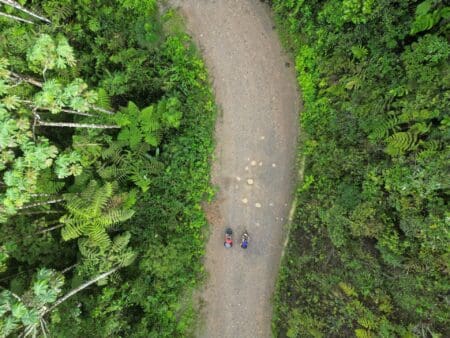
Some days the road barely seemed to qualify as a road. There were stretches of gravel, broken tarmac, potholes, wandering dogs and the occasional tractor. But there were also long stretches where we saw almost nobody.
And that was exactly what we had hoped for.
Georgia is incredibly diverse for such a small country. Within a few days, the dry landscapes of the east had given way to green valleys and forests. Then came bigger and bigger mountains.
We passed through the wine country around Kakheti, climbed through the interior, and eventually found ourselves deep in the Caucasus. The further we went, the more dramatic everything became.


Into Svaneti
Somewhere along the way, the trip stopped feeling like a tour through Georgia and started feeling like an expedition into the mountains. The roads became steeper and the villages smaller. We followed valleys with rivers rushing alongside us, climbing higher and higher until the mountains seemed to close in around the road.
And then there was Ushguli.
Getting to Ushguli was one of those days that makes you question your choice of hobby.
The climb was brutal. Fully loaded Bike Fridays, steep and rough roads, and seemingly endless vertical metres. The higher we got, the quieter everything became. The road got rougher, the air thinner, and the mountains bigger. By the time we finally reached Ushguli, we were completely spent.
And then you look around and realise why you came.

Ushguli sits at around 2,100 metres in the upper Enguri valley and is often described as one of the highest permanently inhabited settlements in Europe. It is a collection of old stone houses, narrow paths and medieval Svan towers scattered across an enormous mountain landscape. Behind it all rises Mount Shkhara, at more than 5,000 metres, dominating the valley.
The towers are what make Ushguli so distinctive. Built mainly between the 9th and 12th centuries, they weren’t built as monuments. They were defensive towers, giving families somewhere to retreat during conflicts between local clans. Some are still attached to houses, while others stand alone, weathered by centuries of harsh winters.
For much of its history, Svaneti was incredibly isolated. The mountains made it difficult to reach and helped preserve a culture and way of life that still feels very different from the rest of Georgia. Standing there, surrounded by the towers and enormous mountains, you can understand exactly why.
That evening, with our legs still recovering from the climb, we watched Dede, a highly acclaimed Georgian film set in the remote Svaneti region in the 1990s. The film follows a young woman caught between Svan traditions, family expectations and her own desire for freedom. It was filmed in the Svaneti mountains and villages, so watching it after cycling through the region made the story feel surprisingly close to home. The landscape we had spent the day riding through suddenly became part of the story on the screen.
There is something special about arriving somewhere like this under your own power. After hours of climbing, Ushguli didn’t feel like another stop on the route. It felt like a reward.
You don’t just see Ushguli.
You feel like you’ve earned it.


And then there was Mestia…
From Ushguli, we continued towards Mestia. After the remote, almost timeless feeling of
Ushguli, Mestia felt like a completely different world. There were cafés, guesthouses,
restaurants and considerably more people. Almost civilisation again.
Almost.
But the mountains hadn’t gone anywhere. Mestia sits in a spectacular valley surrounded
by enormous peaks, with the distinctive Svan towers rising above the town. After the
isolation of the previous days, it was a good place to slow down, eat far too much and let
our legs recover before continuing the journey.

From mountains to the Black Sea
Eventually we left Svaneti and started heading west. The landscape changed again. We
dropped towards the Black Sea, passing through green valleys and small villages before
reaching the coast around Poti.
Then, because apparently we hadn’t climbed enough yet, the route turned back into the
mountains. This was one of the things we loved most about Georgia. You can never quite predict what
is coming next. One day you’re riding through a humid coastal landscape, the next you’re
climbing a tiny mountain road surrounded by forest.
The stretch from the Batumi area towards Khertvisi was probably one of the most beautiful
parts of the entire trip. The valleys were ridiculously beautiful, with rivers cutting through
the landscape and mountains rising on both sides. It was the kind of riding where you stop
taking photos because you’d have to stop every five minutes.
And Georgia has a funny way of making you pay for beautiful scenery. Every time we
thought, this must be the most beautiful part of the trip, the road would turn upwards. Again. And again.
Almost 19,000 meters of climbing doesn’t happen by accident.


We probably ate our way across Georgia
Fortunately, Georgia has excellent recovery food. Actually, calling it recovery food probably
isn’t fair. We simply ate extremely well.
Khinkali became a regular part of our diet. So did khachapuri, fresh bread, cheese, grilled
meat, beans, vegetables and anything involving walnuts.
And for the coffee addicts. You’ll find great speciality coffees in the bigger cities.
And then there was wine.
Georgia has an extraordinary wine culture, with traditions stretching back thousands of years. We encountered wine everywhere. From proper wine bars to small family restaurants where someone would simply put a bottle on the table.
The traditional qvevri method, using large clay vessels buried in the ground, is still part of Georgian winemaking today.
After a long day on the bike, sitting down to a huge Georgian meal with a glass of wine was hard to beat. But it also made the next morning’s climb slightly less appealing.


Finding the little things
We also had a little help along the way from something we carry on every bike trip: Rolling Around. It’s an app built by bikepackers, for bikepackers: A community map where cyclists share places and useful information from the road.
In Georgia, it was especially helpful because so much of our route was away from the main roads. We used it to find accommodation, food, places to leave our bike cases, and even shops selling the right gas canisters for our stove.
And it wasn’t just about finding places. We even met other cyclists through the app. A couple from Switzerland and another cyclist from Belgium.
Whenever we found something that wasn’t already on the map, we added it ourselves. That’s what makes it useful: cyclists sharing what they find, so the next person has a little
more information than we did.

Back to Tbilisi
Eventually, after crossing mountains, valleys and almost the entire country, we turned back towards Tbilisi. By then, it was the little moments that had stayed with us.
Georgia is simply breathtaking. Around almost every corner there was something new:
enormous valleys, snow-covered peaks, deep gorges, tiny roads winding through the
mountains, and beautiful monasteries and ancient castles appearing seemingly out of
nowhere.
But perhaps what we’ll remember most are the people. Again and again, strangers invited
us to stop, eat, drink and sit with them. Sometimes it was just a quick conversation at the
side of the road, sometimes an entire evening around a table with far more food and wine
than two cyclists could possibly consume.
Those encounters were impossible to plan, and that’s exactly what made them special.
We came to Georgia for the riding and the mountains. We left with tired legs, dirty bikes
and a lot of memories of the people who made the journey what it was.

Follow along for more adventured from Max and Audrey on these platforms: